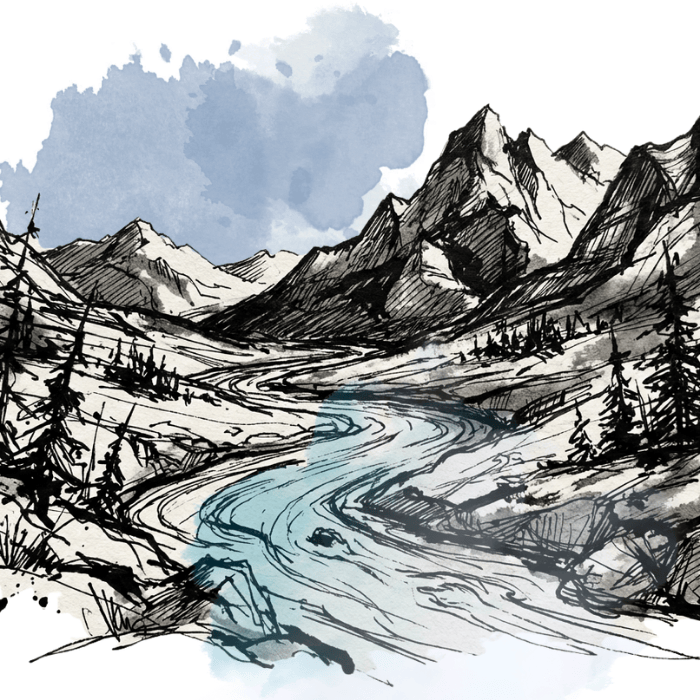

The mighty Indus has always been more than a mere waterway. Running more than 3,000 km from Tibet, through the entirety of Pakistan, where the river finally meets the Arabian Sea, it has flowed for centuries, sustaining civilisations and communities across South and Central Asia. For the people of Sindh, the Indus River is revered as Sain Hu (meaning the Lord), the giver of life.
The Indus River has long been the lifeblood of Sindh, sustaining generations. Along the Indus, farmers timed their planting to its floods. Fisherfolk followed its currents toward the delta. Entire villages built their traditions, economies and identities around its rhythms. Where the Indus met the sea, vast mangrove forests grew up to shield the coast from storms and acted as a critical natural barrier against devastating coastal floods.
This relationship between the water and the people it sustains is now fracturing.
In the early months of 2026, stretches of the Indus look different than they have in living memory. The once-torrential waterway in its lower reaches is now a landscape of parched earth and creeping salinity. Canals that once ran full during planting season are running thin. In some districts, farmers are walking across riverbeds their parents could only cross by boat. This is not the story of one bad season. It is a pattern that has been building for decades, and the people living inside it have had almost no say in how it came to be.
To understand how this happened, you have to go back more than a century.
During British colonial rule, administrators built one of the largest irrigation networks the world had ever seen across the Indus basin. It worked, in the sense that it dramatically expanded agriculture. But it also rerouted the river through an elaborate system of canals and barrages, restricting the Indus from its natural course. After independence in 1947, Pakistan kept constructing. More dams followed. More diversions. The Indus was increasingly treated as a national asset to be managed from above, rather than a living system that communities depended on.
Large projects like the Diamer-Bhasha Dam have been sold to the public as national necessities. But the Sindhi people were not at the table when these decisions were taken. Instead, they are the ones living with the consequences. The river that once moved according to glacier melt and monsoon cycles is now regulated by reservoirs and release schedules set far away, by people with different priorities.
The 1991 Water Apportionment Accord was supposed to offer some protection, a formal agreement dividing the Indus's flow among Pakistan's provinces. But a right on paper is only as meaningful as the willingness to uphold it. For decades, the people of Sindh have watched the accord interpreted in Punjab's favor, while the reality on the ground tells a different story.
Now, the federal government's Green Pakistan Initiative threatens to deepen the imbalance further. The program includes new canal systems intended to irrigate arid land upstream, another major diversion, designed without meaningful input from the communities who will bear the cost.
The consequences are most visible where the river meets the sea. Or rather, where it no longer does.
A delta requires a constant push of freshwater to hold back the ocean. Without it, the sea advances. The Indus Delta once supported one of the largest mangrove ecosystems in the world, a vast, living coastline that shielded communities from storms, sustained fisheries, and held the boundary between land and sea. Today, after a century of declining flows, 92% of it is gone.
The minimum flow of 10 million acre feet promised below the Kotri Barrage is routinely unmet. In its absence, the Arabian Sea has taken over 3.5 million acres of once-fertile land across Badin, Thatta, and Sujawal. The Palla fish, a staple of the Sindhi table and a thread in its cultural life, is quietly disappearing as its breeding grounds turn saline. The mangrove forests, once dense, navigable, full of life, are thinning into ghost landscapes.
“The Indus no longer reaches the sea. It dies in the sands of Sindh, while the salt of the ocean poisons our wells and our history.”
Further upstream, agricultural land is changing too. Soil salinity (kallar in Sindhi) is spreading as the freshwater that once flushed salt from the earth stops arriving. Fields that fed families for generations are turning pale and hard. Recovery is not a matter of waiting for the next rains. It requires water that may not come, released under agreements that may not be honored.
More than 1.2 million people have already been displaced from their homes.
Most have made their way to Karachi, joining the long queue of people looking for work in a city already stretched beyond its limits. Some reports describe this movement as climate migration, a phrase that implies nature is the cause. What it obscures is that the choices driving this displacement were made by people, in offices and ministries far from the delta, and that the communities most affected had no voice in making them.
For those who remain, the decision to stay is not simple. It is made each season, against the weight of wells that no longer yield clean water, of fields that no longer produce, of a coastline that keeps retreating.
There is no single solution being offered here, and the people of Sindh are not naive about the complexity. Climate change is real. Rainfall is becoming less predictable. The population is growing, and the demands on the river with it.
These are genuine pressures, shared across the region. But they do not explain why Sindh has so consistently been the one to absorb the shortfall. That pattern has a different explanation, one rooted in who holds political power, and whose needs federal water policy has historically been designed to serve.
Because underneath the policy disputes and the infrastructure debates lies something that no barrage or accord can restore once it is gone. The Indus is woven into how Sindhi people understand themselves, their history, their language, their sense of continuity with those who came before. When people here say the river is disappearing, they are not speaking only about water. They are describing what it feels like when the ground beneath a culture begins to give way.