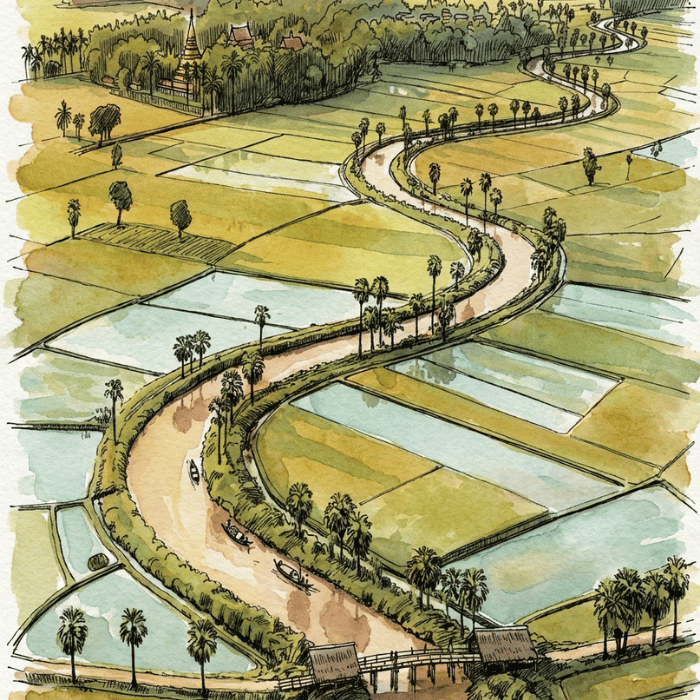

For the Khmer-Krom people, water is more than a natural resource; it is the foundation of identity, spirituality, and survival. As Indigenous Peoples of the Mekong Delta in southern Vietnam, they have shaped culture, economy, and religious life around rivers, canals, monsoon floods, and fertile soil for countless generations. Their homeland, known in Khmer as Kampuchea-Krom, has always depended on the gentle rise and fall of the Mekong. Freshwater once promised full rice fields, healthy fish, and peaceful village life. Water has never been separate from the people. It has been their food, memory, and inheritance.
From early childhood, Khmer-Krom children learn the language of water. They learn to read the tides, to feel the coming rain, and to recognize the color of river currents. Water tells them when to plant rice and when fish will return to the flooded fields. It signals temple festivals and family gatherings, shaping both daily life and sacred traditions. Canals are not only for irrigation; they are places where elders teach stories, children learn to swim, and Buddhist monks bless the land at the changing of seasons. Through these waters, knowledge and identity pass quietly from one generation to the next.
The Mekong Delta is now one of the most climate-vulnerable regions on Earth. Much of its land lies less than two meters above sea level, and every year it sinks further due to heavy groundwater pumping, sand mining, and dams built far upstream. The sea is moving closer. Saltwater pushes deeper inland, turning rivers, rice fields, and wells bitter. Places that once provided safe drinking water are now contaminated, damaging crops and making people sick. Freshwater is becoming scarce, uncertain, and fragile, leaving communities constantly worried about what the next season will bring.
For Khmer-Krom villages, these changes are a part of daily life, not theory. Rice fields that once glowed green now crack with salt. Canals that brought clean water now carry brackish tides that burn plants and rust tools. Fish that once fed families vanish from polluted water. Women walk farther each year to find drinkable water, while children suffer from skin diseases caused by dirty canals. Elders speak quietly about seasons that no longer follow familiar patterns, as if the land itself has lost its memory.
As water disappears, so does security. Families worry about food, about illness, and about how to live with dignity. Farming, once guided by rhythm and trust in nature, has become a fragile struggle between floods, droughts, and salt. Many Khmer-Krom farmers say they no longer plan for the future; they only try to survive the present.
This suffering is made worse by government policies that treat the delta as a factory for export rather than a living homeland. Vietnam is one of the world’s largest rice exporters, and much of that rice comes from Khmer-Krom land. Farmers are pressured to grow three rice crops each year to meet national production targets. The old way, growing one crop, caring for the soil, and saving seed for the next season, is disappearing. In its place is intensive farming that depends on expensive chemical fertilizers and pesticides.

For Khmer-Krom farmers, this has created deep injustice. They work harder than ever, yet earn less. Fertilizer, pesticides, fuel, and irrigation costs more each year. The soil becomes weaker, the water becomes dirtier, and fish die in the poisoned canals. The same water that feeds the rice slowly harms the people who drink it. Fields that once provided both food and fish now bring only debt and anxiety.
Farmers borrow money to buy chemicals, then borrow again when saltwater destroys part of their harvest. When harvest season finally arrives, the suffering does not end. Buyers often do not come to their villages, and rice prices collapse at local markets, leaving farmers with sacks of rice but no fair way to sell them. With loans due and families in urgent need of cash, they are forced to accept whatever price is offered, no matter how low. Debts continue to grow until families must sell their animals, their farming tools, and eventually their land. On paper, production increases. In real life, poverty deepens. Water, once a source of life, becomes a source of fear.
Farming loss is profound. For the Khmer-Krom, water unites culture. Rice fields and rivers are classrooms, temples, and history. Traditions rely on the land’s rhythms. Buddhist monks bless canals, and stories link to the landscape.
When crops fail, and fish disappear, families fall into debt. When land is sold, families lose more than property. They lose their roots. A field is not just soil; it is where grandparents taught children how to plant rice, where families built small shrines for the spirits of the land, and where neighbors shared meals after harvest. Losing land means losing living memory.
This collapse forces families to leave. Parents travel long distances to work in factories, often across provinces or even borders. Children grow up in crowded cities without learning the Khmer language or Buddhist teachings. They forget village ceremonies. Traditions fade. Communities weaken. What begins as environmental loss slowly becomes cultural loss, until climate change steals not only land, but identity.
Even so, Khmer-Krom communities remain almost invisible in national climate plans. Vietnam receives billions of dollars for “Mekong Delta resilience” projects, such as canals, dams, sea walls, and irrigation systems. Yet Khmer-Krom villages are rarely consulted. Projects are planned in distant offices, and decisions are made without the people who drink the water and farm the land. Their suffering is rarely counted, and their voices are rarely heard.
This exclusion is not accidental. The state refuses to recognize the Khmer-Krom as Indigenous peoples. As a result, their right to be consulted is ignored, and international principles such as Free, Prior, and Informed Consent do not apply to them in practice. Dams are built, water is diverted, shrimp farms expand, and roads cut through farmland, while small farmers are left unprotected. In government reports, the disappearance of Khmer-Krom land is called “natural erosion,” not the slow destruction of an Indigenous homeland.
For the Khmer-Krom, the fight for water is therefore also a fight for dignity and human rights. Their communities hold deep knowledge of the delta. Elders know how to guide floods into fields to restore soil, how to rotate crops, how to protect riverbanks, and how to grow rice that survives changing water conditions. These methods are sustainable, affordable, and respectful of nature.
But Buddhist monks and community leaders who speak about these solutions are often watched, silenced, or imprisoned. Temples are tightly controlled. Independent voices are discouraged. Rivers are managed by people who do not live beside them and do not depend on them to survive. Short-term profit replaces long-term balance, and the people who know the land best are pushed aside.
To the Khmer-Krom, water is not something to sell. It is memory, prayer, and family. The Mekong is spoken of as a living ancestor that has carried its people through centuries of empire, war, and repression. Children are taught to greet the river with respect. Buddhist monks bless its waters. Elders say it teaches patience and harmony. If the river turns fully to salt and poison, more than land will be lost. A people will slowly disappear, not by force, but by neglect.
Protecting freshwater in the Mekong Delta is not only an environmental issue; it is a matter of justice, culture, and survival itself. For the Khmer-Krom, the future of water is inseparable from the future of their children and their identity as a people. They call on the world to recognize their Indigenous status, include them in all decisions about their land and rivers, and support community-led solutions rooted in their knowledge and traditions. These actions are essential for dignity, justice, and long-term survival. When the water is protected, the Khmer-Krom people can endure.
Paid subscription, amplified impact: help us represent more voices.